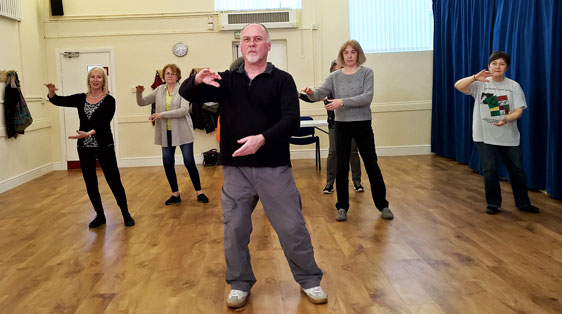
One of the things that I fhave found paradoxical about Tai Chi and Martial Arts in general over the years is the balance between practice and the thinking about it – gradually I have accepted that we need to do both and I’ll just do it my way – so my mind just keeps on thinking about this stuff and related matters – after all once you get into Tai Chi it all seems related anyway. So in that vein I have put some more articles on the Shefford Tai Chi website – they are not all filled out completely – but I’m sure readers can fill in the gaps for themselves:
Tai Chi – important behaviours - this is a recent piece about behaviours that are useful in a fight – and elsewhere – with some notes on Chi at the end
Physical awareness and non-verbal communication - an older piece that does what it says on the tin
Nobody ever said that a Zen Master had to be patient! - it seemed a point worth exploring.
Feedback and Education in Tai Chi - pretty much about feedback and education in Tai Chi – from a personal perspective – isn’t it all?
A few useful strategies - as much about life in general as about Tai Chi
This year we are working with The Letchworth Centre for Healthy Living to promote World Tai Chi & Chi Kung Day on April 28th at Rosehill, Hitchin Road, Letchworth. SG6 3NA
The program includes:
Mini taster sessions of Reiki, Cranial Osteopathy, Shiatsu Massage, Seated Massage, Reflexology, from 10:00-2:00
T’ai Chi, Chi Kung, Alexander Technique & Gentle Movement Workshop from 1:00-4:00
To celebrate National Tai Chi Day, this workshop and mini therapies will provide an opportunity to learn more about techniques and their benefits.
The afternoon workshop will include:
Principles of Alexander Technique to support T’ai Chi /Chi Kung practice with flowing T’ai Chi dance movement, individual hands on Alexander Technique; T’ai Chi, Chi Kung, Yiquan exercises; T’ai Chi postures and forms; meditation and demonstrations.
Half day workshop – £20
Mini taster therapies – £10 for 20 minutes
Tutors – Ian Deavin and Judy Hammond
For further information or to book call 01462 678804 /jaqui@letchworthcentre.org
I am delighted that we are now holding a daytime beginners class at The Letchworth Centre for Healthy Living as part of their Community Program - which also includes Group singing and Latino dance.
The Tai Chi class is on Monday mornings at 11.30 to 12.30 when we do some gentle exercises aimed at improving balance and mobility – and generally enjoy the community environment of the centre - for me at least this includes the now re-opened “Rosehill Cafe” which provides lovely food, excellent drinks - and banter if you are lucky!
Click here for more information
Hi – and Happy New Year :^)
I’ve just finished reading “Why the West Rules – For Now” by Ian Morris – pub Profile Books ISBN 978 84668 208 7 – in my case borrowed from the library.
Quite weighty at 622 pages but a fairly easy read written with insight and humour it gives a very interesting perspective on human development over the ages.
It certainly gave me a lot to think about in terms of the east/west cultural exchange of which our own participation in Tai Chi is a part.
We were discussing this recently in one of my beginners classes – not that there was any doubt of the benefits of Tai Chi – but the class was looking for a way to encapsulate their thoughts.
It was of course different for everybody – but may I sugest that for most of us the main value is in what we learn about ourselves and how we work in all our facets. That in fact each person re-discovers for themselves the internal aspects using practice of the exercises and forms to experience, learn and develop ourselves. And that this is quite different for each of us, although seen externally as quite similar – each fish experiences the river differently but the water still flows downhill. Whether you are concerned about falls prevention or martial arts application this thread is common and crucial.
Tai Chi is becoming very popular these days and it seems to me that there is something of the “magic bullet” about the way Tai Chi is regarded – a bit like going to the doctor – “take this course of Tai Chi and everything will be better” – indeed 16 weeks or whatever of Tai Chi classes can have a significant effect – but that really is just the start. The point is to learn the skill of understanding one’s body and using it better so that our own internal systems can heal us and keep us healthy. The concept of Chi is part of that but something that each of us comes to understand on our own. No magic – just hard work and understanding.
I have noticed over the years that I have had a number of students with sporting interests - such as golf or running – who have told me of their improved sporting performance following a period of Tai Chi practice. I think the first I remember was one who said he reduced his handicap by 3 or 4 strokes – and another who altered his running gait and so relieved a leg problem. This seems to be a common Tai Chi experience – for example with Ballet dancers learning Tai Chi to improve their balance and fluidity – and is summed up in the expression ” you can put Tai Chi into anything, but you can’t put anything into Tai Chi”.
Given a history of 400 years plus of studying the human body and it’s movement in relation to other people and the rest of the world - it is not surprising that Tai Chi already encompasses most aspects of the human experience and so forms a core resource – a repository of refined information of great value to all paths of human interest.
I’ve done quite a bit of work recently teaching Tai Chi as a falls prevention program, with some brilliant feedback – but it has got me thinking a lot about the wider aspects of the subject and led me to produce a whitepaper on the considerations of setting up a Tai Chi based falls prevention program – the whitepaper is available on the main website along with examples of the feedback.
I suppose the main point that I noticed is that if one tries to focus on those epeople known to be at risk of falls – eg over 60 yrs old , then there is a huge variation in capabliity and it requires a greatly increased level of input. Ideally therefore I suggest that one should start one’s program earlier say at 50+ when people still have a significant capability and another 10 years to learn the skills involved in the Tai Chi approach before their risk of falls becomes critical. This would truely be a falls prevention program – although it would probably be more appropriate to call it something like “balance and mobility for the over 50s”.
Anyone looking to set up such a program can contact me to discuss.
More practice, move naturally, relax, sink lower – injunctions we all receive no doubt from our teachers along with – do not use strength, just be in the present – and on this point it seems to me that the western educated mind is often the problem – but if one has an intellectual, western educated mind then it is too late to get rid of it - and so it also becomes the only tool to find the way out – by deciding to let it go. Intellectuals are often so wedded to their intellect as a way of life that they are not clever enough to realise they must let go of it in order to experience reality and their own broader human potential.
Oh and they can keep their intellect but now in its rightful place as a tool of the whole organism.
At least that has been my experience – doing it of course is difficult :^)