≡ Menu
The Letchworth Centre for Healthy Living

This is an extension of the Letchworth Centre Monday Tai Chi exercise class, with emphasis on learning how to look after yourself especially in terms of health and falls prevention.

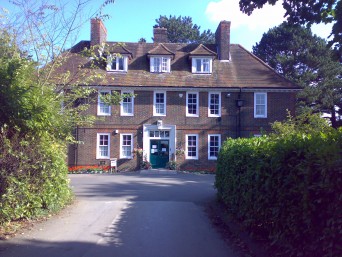
Venue: The Letchworth Centre for Healthy Living, Rosehill Hospital, Hitchin Rd, Letchworth Garden City, SG6 3NA, 25th May 2016, 2-4pm
Cost: £15 in advance, £18 on the day
This seminar is an extension of The Letchworth Centre for Healthy Living Monday Tai Chi for falls prevention community class

To book telephone 01462 678804. You can also book online

Please wear suitable loose clothing and flat soled trainers or similar

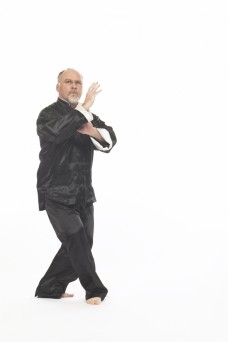
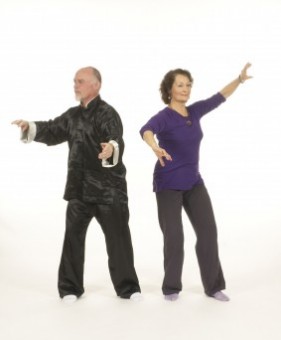
Ian Deavin demonstrates stepping to the corner

I was thinking that people often present very differently to the way they are inside – some present as relaxed and confident but look at their bitten nails (no don’t look at mine!), many say good things about being honest but when it comes to it costing them then they let you down and it is only when you give them a chance to let you down that they show themselves. Others can appear weak and simple but turn out to have great inner strength and honesty – there is a Tai Chi expression about ” investing in loss ” which is primarily about letting yourself be vulnerable in order to find out your own weaknesses but it works the other way as well – if you show some vulnerability then it encourages the other person to let their guard down and reveal more of themselves.

I believe that most of this comes down to how people deal with their inner fear – everybody runs away at times, the real question is how do they do it – honestly or by blaming others?

We all have expectations about this – that if someone has one trait then they surely have another, but that so often trips us up and they turn out to be other than we expect.

Another martial arts metaphor likens a person’s development to the forging of a Japanese sword – we go through high energy times (high pressure or real fun stuff) – fire and low energy times (depression or relaxing) – cooling, and good steel gets stronger, more flexible and resilient the more it is worked until it is finished. Of course it needs polishing and looking after but at the end of the process a good person/sword is beautifully vibrant and balanced, able to deal with almost anything. We all have our limits of course but the trick is to recognise a good sword.

Interestingly I had the opportunity some time ago to handle some genuine Japanese swords at a museum collection where the curator was an enthusiast. Most felt like cold lumps of steel but one – made in 1360 – had a life of its own – it just felt like it wanted to move on its own. It looked nothing special, simple design, not highly polished, not very large, with some spots of rust and obviously well used, but once I held it I was in no doubt it was the real thing – then the curator told me its age – from a time when swords were made to be used and Samurai trusted a sword with their life, as opposed to later periods when they were often for show. In fact the Japanese master sword makers often did not sign their work saying that if a swordsman could not recognise a good sword without a label then they didn’t deserve it.

And a good teacher is like a good sword maker – pushing the steel to be the best it can be.

World Tai Chi Day


I am delighted to be running a seminar to celebrate World Tai Chi & Chi Kung Day – joining with practitioners around the World to share the energy of a day’s practice together.

Venue: Shefford Community Hall, 60 High Street, Shefford Bedfordshire, SG17 5AX
30th April 2016, 9.30am-12.30pm
Cost: £30 per seminar for bookings up to 1 week before the seminar. £40 after

To book telephone 01462 621970 or email: [email protected]

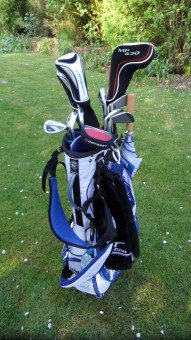
Tai Chi for Golf

All these activities are very different in many ways – but all share the core of Tai Chi practice – balance, relaxation, posture, power, mental and emotional aspects, plus the sensitivity to relate physically – either to the environment, other players or body extensions such as bats, balls etc. Even in the workplace we find manual workers needing to take care of their bodies, skilled workers needing to balance their body with mental/emotional factors so as to enhance and extend their ability – intellectual workers also find a similar need lest they ignore the non-intellect and find they become no longer able to perform intellectually to the level they aspire.

Tai Chi becomes useful simply because it is in one sense a collection of proven exercises which guide one to an optimal balance. The combination of physical practice with intellectual and emotional awareness is invaluable in itself, however at the core of Tai Chi is the movement it encourages – movement and a way of moving – indeed a way of thinking about moving and of relating with the “outside” that works to maximise the human potential.

Tai Chi’s focus on “natural movement”, principles and power means that the way of moving derived from practice is easily transferred across all areas of human activity and in particular this is often seen most clearly in sport where golf handicaps may tumble, or relaxed focus may be increased, but is also seen in reduced back pain while at a computer or steering wheel and even in improved writing ability.

By not seeking to “force” any particular pattern the Tai Chi practitioner seeks to allow the body to move easily in a centred way – we do this by cultivating certain principles which include centred segmented movement, upright poise, full/empty weighting, opening/closing of all parts of the body, sensitivity, awareness, relaxation, fluidity, light limber movement, absorption, neutralising, deflection, internal power and release of power.

Consequently one may access Tai Chi exercises which promote:
–    Balance
–    Meditation – quiet mind – quiet body
–    Good structure
–    Resilient soft tissues
–    Relaxation in movement
–    Centred movement
–    Sensitivity to the environment
–    Sensitivity to other people
–    Strength
–    Co-ordination
–    Physical connection
–    Mental and emotional awareness
–    Good breathing
–    Good posture and poise

It may be no surprise that many of these may be the same exercise – on the principle that “it is not the exercise you do – it’s what you do in the exercise.”
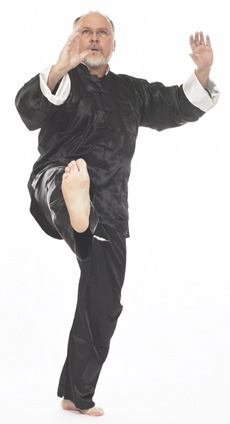
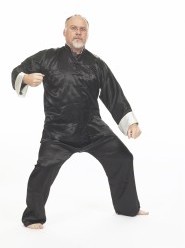
Ian Deavin demonstrates Chen Laojia form

Many like myself started in martial arts training with Shotokan Karate instructors who, while doing their absolute best, missed something, because the early Japanese instructors couldn’t pass on subtle details. The cultural/language barrier was simply too big to breach in one go.

My Chinese (Tai Chi) instructors are always talking about ‘feeling’ and much of my learning these days comes from being given the opportunity (or setting myself up for it), to experience different ways of being. Interestingly, this touches on the Chinese idea of ‘true transmission’ from a master, where subtle aspects can only be passed on, one-to-one. Also it gives us another answer as to why Kata (or forms in soft arts) are considered the soul of a style. How is it that a really efficient fighter can develop only from practice of one form? Partly, I believe because each form contains the full expression of its originator (his soul). As we learn a form we learn about its creator and come to experience some of the feelings that he may have experienced. The choreography of the moves becomes a language carrying his ideas and concepts. Only by feeling can we begin to understand the message.

Read the full article here

So: Tai Chi movement is how the human body moves when we are relaxed and move from the centre.

We could find this on our own – but mostly we benefit from the guidance of a knowledgeable “other”. My patient teacher, Karel Koskuba, shared with me that I should not seek to explain things to my students – explanations are always wrong and confusing – students must learn to copy the teacher and observe their own bodies. A bit like a guide taking you on a trip or following a satnav.

So there you have it- copy and observe.

Oh and practice – a lot – so you can observe some more and integrate the changes.

Tai Chi in Hitchin

Our original Chen Style Tai Chi, weekly beginners/improvers drop-in classes will be moving to a new venue from the 11th March 2016 with a new time of 19.00-20.30. – so students will benefit from a longer class (1 1/2 hours), for the same price as previously (£7.00).

Venue: Tilehouse Street Baptist Church, Upper Tilehouse Street, Hitchin, Hertfordshire, SG5 2EE. Get directions and further information.

Chen style Tai Chi Chuan or Taijiquan is valued for health, relaxation, personal development and martial arts. It is believed to be the original codified version of Tai Chi and is considered suitable for all ages. Chen-style focuses on softness with calm relaxed movement, balance, good posture and a quiet mind. Developing awareness of inner body feelings and of mental/emotional states is seen as an important aspect.

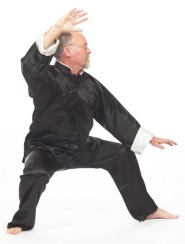
Ian Deavin demonstrates Chen Laojia form

Some notes on Relaxation, Speed, Power, Flexibility – a Physical, Mental and Emotional Triangle looking at what we mean by these terms and how they are linked. This piece was written many years ago but I still believe is essentially correct and hopefully a useful piece of the jigsaw.

SPEED

To say that speed is about quickness sounds trite but somehow the word speed carries connotations of power and perhaps the idea that fast movement should feel powerful at the same time. In fact it seems true that if an action feels fast in these terms then it probably isn’t and you are probably trying too hard. The true feeling of ‘speed’ has more to do with effortlessness than with feeling ‘powerful’.

POWER
The ability to work at a particular rate in mechanical terms can also be seen in the ability for example to break blocks, tiles etc., as in many martial arts films or demonstrations.

Focusing all our energies with total commitment in a specific way enables a great deal to be achieved in a split second. Here perhaps we can find a hint of how this concept can apply in wider areas – achievement. For the point about power in relation to human beings is that what we are really looking for is the ability to achieve, so direction in an effective way is essential.

FLEXIBILITY
When the irresistible force meets the immovable object then something has to give. Too much structure with everything tied down too tight leads in the end to grid lock.

Every system needs a certain amount of ‘slack’ to operate in the real world – to be without is to be robotic and even with robots then the more sophisticated we make them the more flexibility we need to build in.
Read the full article here.

Ian Deavin and Judy Hammond – Tai Chi and Alexander Technique

Covering exercises, spiralling movement, Qigong, mindfulness, meditation, Tai Chi principles and Alexander principles.

The seminar will be run by Ian Deavin and Judy Hammond and participants will be engaged in a fascinating mix of meditation and movement, creating inner body awareness and developing a practical and spiritual mind/body link of considerable strength.

Qigong is a basic training method of Tai Chi coupled with body spiralling, also found everywhere in the movement of dance and the natural world. Principles of Alexander Technique posture and relaxation aid in achieving good balance and relaxed easy movement – developed by Tai Chi practitioners into a way of creating powerful body centred action.


Venue: The Letchworth Centre for Healthy Living
Rosehill Hospital, Hitchin Road, Letchworth, Hertfordshire, SG6 3NA
13th March 2016, 9.30am – 12.30pm
Cost: £45 per seminar for bookings up to 1 week before the seminar. £55 after

To book contact The Letchworth Centre for Healthy Living on 01462 678804

Please wear suitable loose clothing and flat soled trainers or similar

Ian Deavin demonstrates Chen Laojia form

The martial arts are about brutal fighting, right?  Well, yes and no.

Certainly alongside sex, fighting is probably the second oldest form of interpersonal relationship and as such provides the dark side of the human mirror.  However, being so old a good deal of thought has gone into improving techniques.  In the west this has evolved into a search for mechanistic solutions leading to more powerful weapons and with this has come a distancing of the combatants from the deaths they cause.  Martial arts in the west on a one to one level have been modified into sports such as boxing, wrestling, fencing, or side-tracked completely into games such as football.  They have largely become outlets for competitive energy, safe challenges or ways to keep a body fit and make it live longer.  They are many other things too, to participants and spectators alike (not the least of which is being part of our growing leisure (sic) industry, but they have generally been rendered “safe”.  The element of life and death has been addressed and as far as possible removed.

In the east however (and elsewhere) it seems that for many cultural reasons a different path was followed.  The adoption of technical solutions was relatively delayed and the idea of personal combat came to be seen in stark terms connected to and integral with all aspects of life.  Not just a library of techniques or a physical solution to a problem but a way of being, of living and of becoming.  In short, a path of personal development.

Once we look inward to ourselves in the martial arts we are on dangerous ground, for they are one of the few human activities which combine all our facets and require only our naked selves. We begin to use the intellect and the body in combination with the raw emotions of our spirituality.

It has been said that many roads lead to the top of the mountain of life.  This is one road that often attracts with an outer show of external power, and for many this is enough, but once our needs for self defence have been met (and in modern society these are after all fairly minimal) then there is often a feeling of anticlimax, a gap. It is here that many stop.

Read the whole book here.