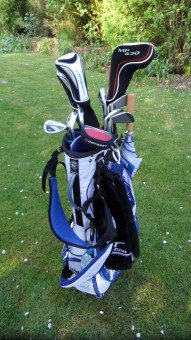
I had the opportunity to test swing a few good clubs yesterday – and chat with my instructor James about the feel and balance and how the clubs work – and I was impressed by the feel of the drivers which in some cases seem to float and to have a balance and feel similar to a good sword – but was not inpressed with the irons – until James offered a Japanese Mizuno from his own set which had a much smoother feel and got me thinking further about the whole question of extending one’s body with a tool – sword makers have been working on this for thousands of years – it is not surprising that there has been similarity of development.
I recall being told that the part of a Japanese sword that was used for cutting is the top 4 inches from the tip – so everything was designed around focusing all the speed and power at that part of the blade – pretty much the same as a golf club.
The best sword I ever handled was made in around 1360 and had clearly been used for real – it was quite worn and had small nicks – it came from the high period of Japanese sword making and useage between 900 and 1450 AD – it was quite unremarkable to look at and unsigned like many of the best ones – on the basis that if you couldn’t tell how good it was by the feel of it then you didn’t deserve it anyway. It felt like it had a life of its own and I can well understand the way a very good sword was regarded by people whose life daily depended on it. I imagine that this was a common experience around the world since the need was the same wherever swords were needed.
Surely the same principles apply to any tool or extension to our bodies in achieving the kineaesthetic feel and the mechanical strength to convey power with control from the centre of our movement to the end of the implement – which brings me back to thinking about Chi – and the flow of that power from the centre of the body where we initiate it radially out through our limbs and by connection fluidly along the shaft to the end where it is needed. It is certainly true that when I make a good shot I am barely aware of hitting the ball ( or how I did it ) the flow of power is a lovely feeling. Tai Chi principles all the way!
Does this perhaps explain some of the popularity of Golf – in that it appeals to the ancestral feelings of swinging a weapon in the outdoor world against the elements – very grounded in reality and using ones body in a very integrated way - the golf warrior in fact!
I had my first one-to-one golf lesson yesterday and was delighted to have a number of familiar metaphors suggested to me – among them – to not focus on the ball but to consider the ball just gets in the way ( very Zen ) as an opponent “just gets in the way of my punch”, to keep a straight back so that I turn about my central axis ( classic Tai Chi ), to create a connection with the club head through my body by relaxed opening of the joints so that I pull it through like pulling an extension of my arm ( perhaps a sword ).
Culminating in my finding that good shots follow from the “right” - ”Sung” feeling in my body – funny that!
So we spent some time looking at ways of arranging my body in relation to the club/ball to achieve this feeling – with detailed corrections including hands on adjustments - just like in Tai Chi. Excellent - and really adding to my enjoyment of learning to play.
Contact James here for golf lessons at Mount Pleasant Golf Club.
It was my final golf lesson yesterday – out on the course and after feeling pleased with myself with the putting, chipping and driving in previous classes naturally it was all different playing the holes for real! Just like doing push hands with another person for the first time.
Actually it is perfectly understandable – coming cold to a ball and getting everything right immediately reminds me of story about the Japanese sword tester at the peak of his skill who made an error and managed to nick a valuable blade – not trusting himself again he consulted a Zen priest who recommended he train in a particular type of Japanese flower arranging – which requires partial breaking of each stem – a process that has to be done right first time. By gradual diligent practice with less valuable flowers he regained his confidence and his skill with a sword.
Clearly I have yet to gain any measure of skill – but the answer is the same – diligent practice to gain “golfing Kung Fu” and confidence. Worth a few more extra lessons to see if I can get past the first stage of frustration!
I practiced driving on my own the other day and paid attention to being relaxed – while pulling my right elbow from the centre – this seemed to work well and I managed improved grouping although still only about 7 out of 17 within comfortable reach of the marker @ 100 yds. This gave me some further insight into lu energy – plus it confirmed how important it is to maintain the feeling of the top of the head floating upward in line with the spine while turning about the centre using the waist/hips. Interesting how the Tai Chi approach helps to identify problems in golf and then to sort them out – excellent!
My 2nd golf lesson yesterday – chipping to the green – this time using hips – just as in Tai Chi with some conscious adjustment needed to accommodate the mechanics of the club but basically pulling it through from the centre as one pulls a sword or ones arms in silk reeling – controlling power and body position by sensitivity of the feeling. Ultimately a case of creating an intention ( to put the ball in the hole ) and then letting the unconscious mind/body get on with it. A good example of a complex action requiring consistent perfection – achieved with mindfulness and simplification according to basic principles – very much like practicing a Tai Chi form – with instructor James providing skilled correction and an excellent example to model – good fun!
Never having played golf in my life I had my first golf lesson on Thurs last week and did some practice on my own yesterday – it was interesting to note how loose I need to hold my shoulders to putt properly. And to turn about the chest chakra. Very Sung and soft with a very light grip so that the putter is like a soft extension of the arm – and the arm/putter swing from the body like a flexible pendulum – a weight on a rope pulled by the body movement.
I managed to sink 2 out of 4 from – 4 feet, 7 feet and 14 feet and left with a sense of being able to recognise when I get it right – quite satisfying.
To see an article that relates – click here.
To contact James at Mount Pleasant Golf Club – click here.
I have noticed over the years that I have had a number of students with sporting interests - such as golf or running – who have told me of their improved sporting performance following a period of Tai Chi practice. I think the first I remember was one who said he reduced his handicap by 3 or 4 strokes – and another who altered his running gait and so relieved a leg problem. This seems to be a common Tai Chi experience – for example with Ballet dancers learning Tai Chi to improve their balance and fluidity – and is summed up in the expression ” you can put Tai Chi into anything, but you can’t put anything into Tai Chi”.
Given a history of 400 years plus of studying the human body and it’s movement in relation to other people and the rest of the world - it is not surprising that Tai Chi already encompasses most aspects of the human experience and so forms a core resource – a repository of refined information of great value to all paths of human interest.